
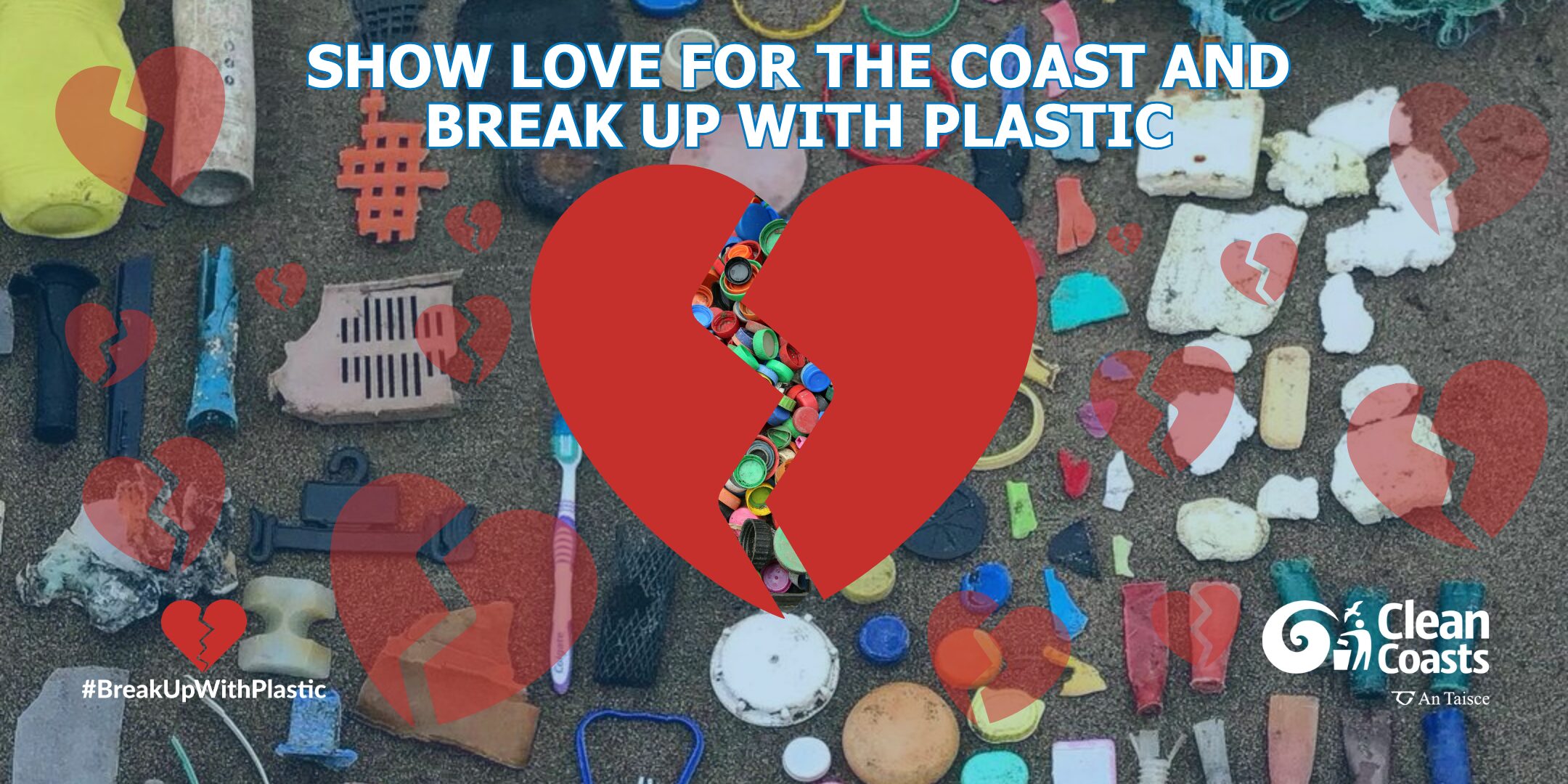
Show your love for the Ocean and #BreakUpWithPlastic
Ditch single-use plastic for Plastic Free July and beyond and commit to a love story that lasts longer!
This July, in line with the Plastic Free July campaign, we are asking you to Break Up With Plastic and reconsider your single-use plastic consumption in favour of a more sustainable, reusable alternative to show your love for the Ocean.
Recent statistics have confirmed that Ireland is one of the top plastic waste producers in the European Union [Source] and over a third of all produced plastic, such as straws, shopping bags or bottles, is used only once and then discarded.
In recent decades, global plastics production has grown exponentially, because of its versatility and low production cost that have made it one of the most widely used materials of modern times.
While plastics help us with the likes of food preservation, construction insulation, electronics utilisation, and the enhancement of vehicle fuel efficiency, the issue lies with our consumption patterns and excessive use of unnecessary single-use plastic (SUP).
The #BreakUpWithPlastic initiative aims to raise further awareness about the global issue of plastic pollution and ask people to stop opting for single-use plastic.
Ireland has some of the most diverse and spectacular coastlines in the world, however, excessive use of plastic is not only damaging and polluting Irish oceans and seas, but it is also threatening our marine wildlife and people’s health.
The good news is – there is a solution to this crisis!
For Plastic Free July, and beyond, join Clean Coasts in ditching single-use plastics in favour of reusable, sustainable products and solutions.
Why should you #BreakUpWithPlastic? Some facts
The average EU citizen generated 36.1 kg of plastic packaging waste per year in 2022. (Eurostat) According to Eurostat, Ireland generated about 66 kg per person, among the highest in the EU. (Eurostat) The amount of plastic packaging used in Ireland is 65 kg per capita, almost double the EU average. (EPA Ireland)
Only around 9% of all plastic waste ever generated has been recycled, while 19% has been incinerated and almost half has ended up in sanitary landfills. The remainder has accumulated in dumpsites or leaked into the environment. (OECD: Global Plastics Outlook)
Recent estimates suggest plastics account for approximately 3.4% of global greenhouse gas emissions across their lifecycle. (OECD: Global Plastics Outlook)
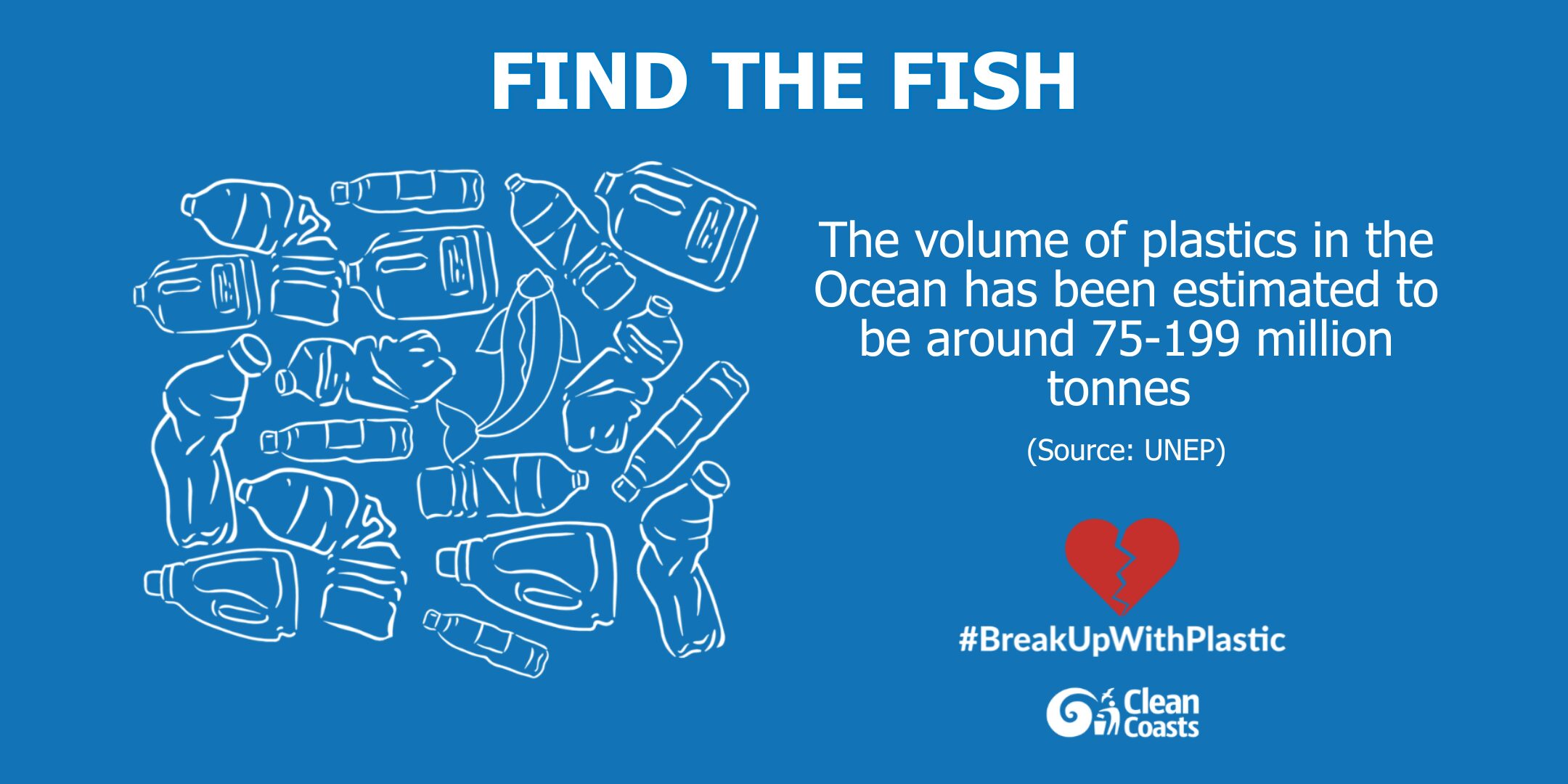
Recent estimates suggest that between 19 and 23 million tonnes of plastic waste enter aquatic ecosystems each year, including rivers, lakes and the Ocean. (UNEP)
Environmental impacts from discarded plastics include littering, leaching of toxic components, and the contamination of ecosystems and the food chain with microplastics — which can end up eventually in humans with unknown health effects.
Recent statistics have confirmed that Ireland is among the top plastic waste producers in the European. (EPA)
Here are some facts:
- Recent Eurostat data indicates that Ireland remains among the highest producers of plastic packaging waste per capita in the European Union. In 2022, the average EU citizen generated 36.1 kg of plastic packaging waste, while Ireland generated approximately 70 kg per person, placing it among the highest producers in the EU. (Eurostat)
- Ireland recycled 30% of its plastic packaging waste in 2023, remaining below current EU recycling targets. An additional 400,000 tonnes of recycling is needed to reach national and EU targets. (EPA Ireland)
- Single Use Plastic Litter can take between 450 and 1,000 years to decompose depending on its make-up, and it never fully disappears, but instead breaks down into smaller microplastic pieces, and plastic waste is suffocating our ocean.
- Nearly 200 million coffee cups are sent to landfill or incineration every year in Ireland. (Department of Environment, Climate and Communications)
- Around 22 million plastic bottles are purchased in Ireland each week. (circular.ie)
- More than 1.6 billion bottles and cans had been returned through Ireland’s Deposit Return Scheme by July 2025. Ireland’s recycling rate for plastic bottles and cans increased from 49% before the scheme to 91% after its introduction. Re-turn estimates that approximately 798 million additional bottles and cans are now being recycled every year compared with before the scheme began. At the one-year mark, 980 million containers had been returned and bottle and can litter had fallen by almost 50%. (return.ie)
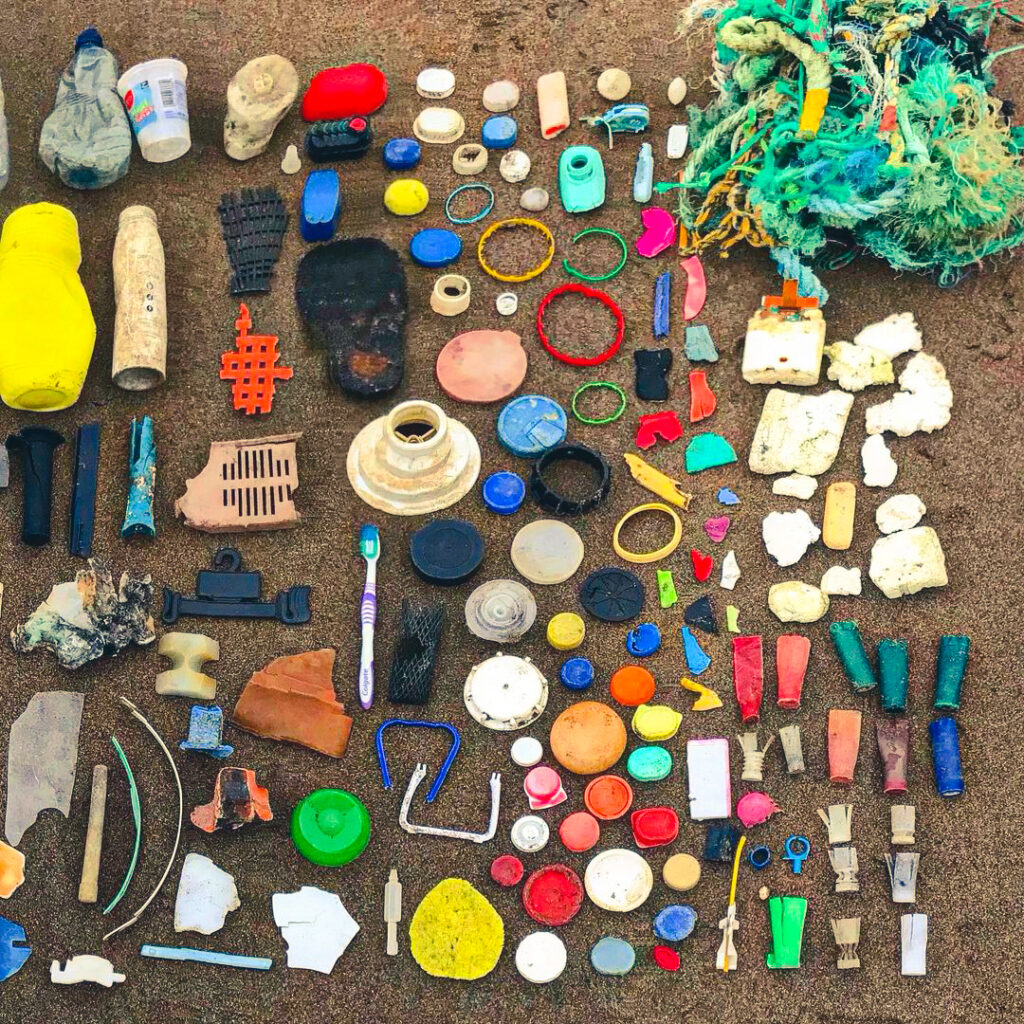
Moreover, according to the Ocean Conservancy Coastal Clean-Up Report 2025 these were the most common items found on the Irish Coast:
- 3,433 food wrappers (candy, chips, etc.)
- 1,210 plastic beverage bottles
- 4,867 cigarette butts
- 1,437 plastic bottle caps
- 537 plastic food containers
- 446 plastic grocery bags
- 831 other plastic bags
- 339 paper cups and plates
- 369 plastic cups and plates
- 344 foam food containers
A love that keeps on giving – Ireland Deposit Return Scheme
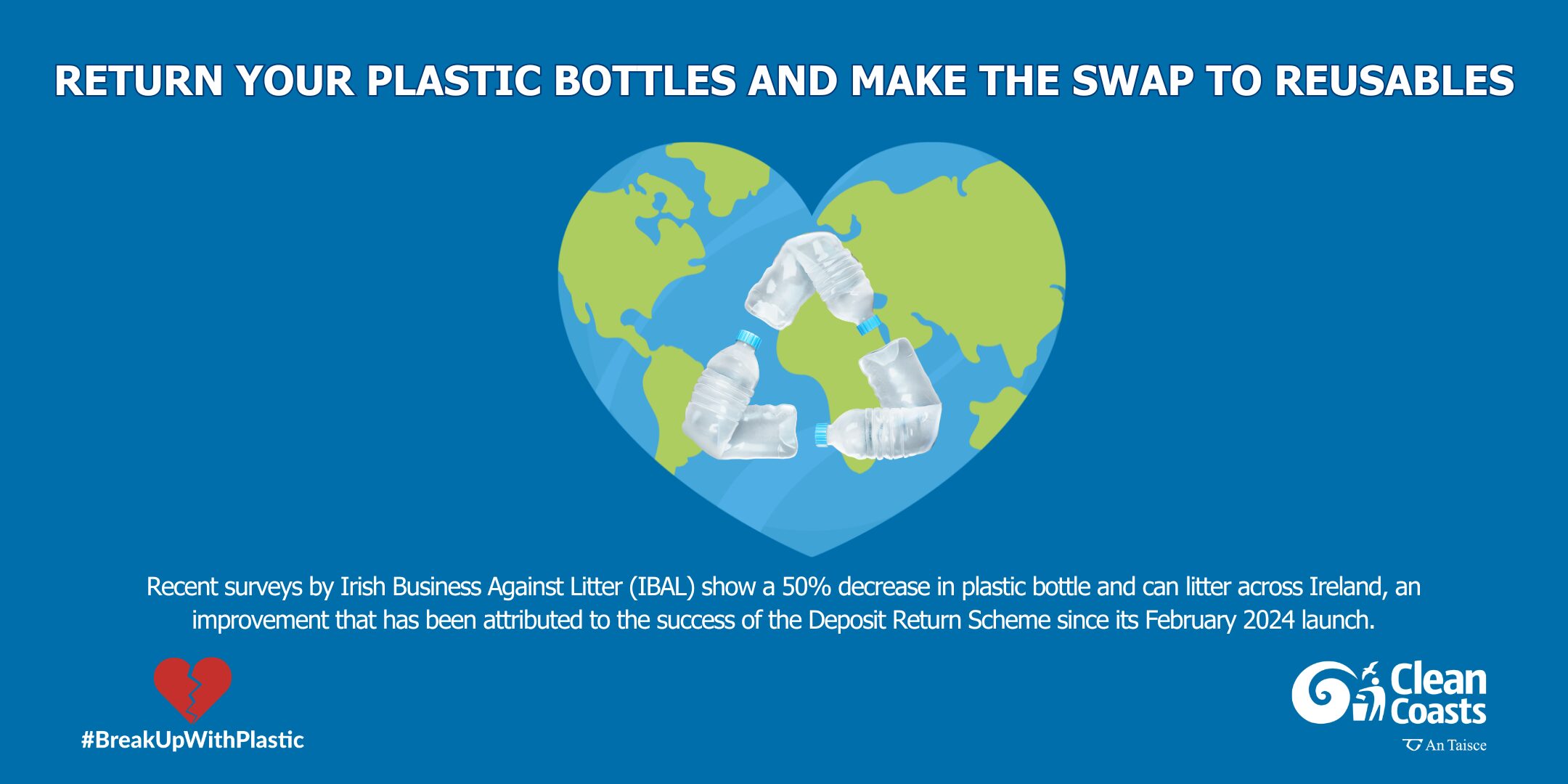
On February 1st, 2024, Ireland rolled out the Deposit Return Scheme, an initiative where plastic bottles and cans with the return symbol on, come with a small deposit to be paid. When you return these recyclables to a return location, you get your deposit back, and our ocean gets some love.
Internationally, Deposit Return Schemes have proven successful in reducing litter. By attaching a small monetary value on these drinks containers, there is more incentive for consumers to return them, rather than creating waste or littering our environment.
Beyond reducing waste and preventing environmental litter, the Deposit Return Scheme reflects a circular economy approach, giving us an opportunity to end our toxic relationship with the ‘take-make-and-dispose’ culture. Instead, it encourages the return of valuable materials, keeping them in the economic loop for an extended period.
We understand that sometimes breaking up with plastic is not easy, and some of our favourite drinks come in a plastic bottle. So, when this happens, the Deposit Return Scheme is the right compromise to make sure to turn our plastic fling into a love that keeps on giving.
Surveys by Irish Business Against Litter (IBAL) in 2026 show a 50% decrease in plastic bottle and can litter across Ireland. (Source.)
Why are we asking people to also #ThinkB4UFlush?
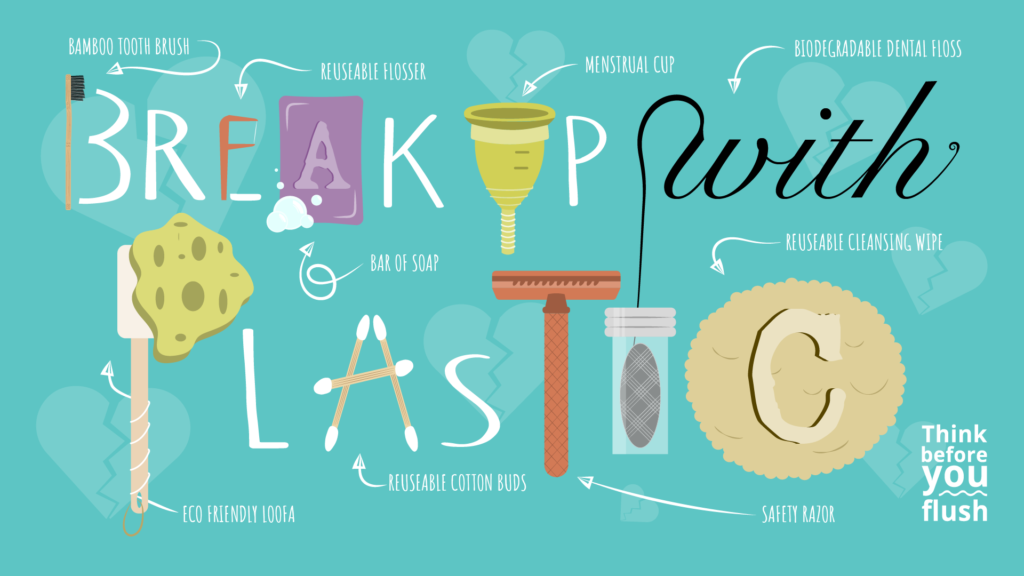
Every day thousands of wet wipes, cotton buds, sanitary products and other unsuitable items are flushed down toilets in Ireland instead of being put in the bin, causing blockages and plastic pollution in rivers, on beaches and in the ocean.
Think Before You Flush is a public awareness campaign about the problems these items can cause in our marine environment and our wastewater systems if they are flushed. Think Before You Flush is operated by Clean Coasts in partnership with Irish Water.
Here are some facts about wipes:
- The misconception that wipes are flushable is leading to blockages in wastewater pipes and plastic pollution in aquatic ecosystems.
- When flushed, the plastic in wipes becomes fragmented and breaks down into microplastics, that do not naturally degrade leading to persistent pollution issues.
- A research study conducted at NUIG found that:
– 50% of “flushable” wipes tested were made of plastic and were not biodegradable.
– 91% of microplastic fibres found were derived from wet wipes and sanitary towels.
– As well as coming in plastic packaging, 90% of the wipes themselves contain some form of plastic.
- There are an estimated 4.85 trillion microplastic particles in the global ocean. [EPA report]
- Microplastics have been detected in shellfish, fish, drinking water, table salt, honey and sugar, beer, fruit and vegetables and chicken. [EPA report]
- Microplastics can be carried in onshore winds in sea salt aerosols, potentially exposing marine workers or individuals residing in coastal regions. [EPA report]
Try #BreakUpWithPlastic and say goodbye to single use wipes and, if you can’t, then make sure you dispose of them properly in the bin. #ThinkB4UFlush
Find yourself a better match
Clean Coasts are asking you to swap the single-use plastic items in your life and look for a better match. Here are some suggestions.
SPENDING TIME OUT AND ABOUT
Let go of your toxic relationship with single-use plastic, and swap for a connection that lasts! Whether you are hiking, shopping, going to work, or meeting your friends, whenever you are spending time out and about don’t forget:
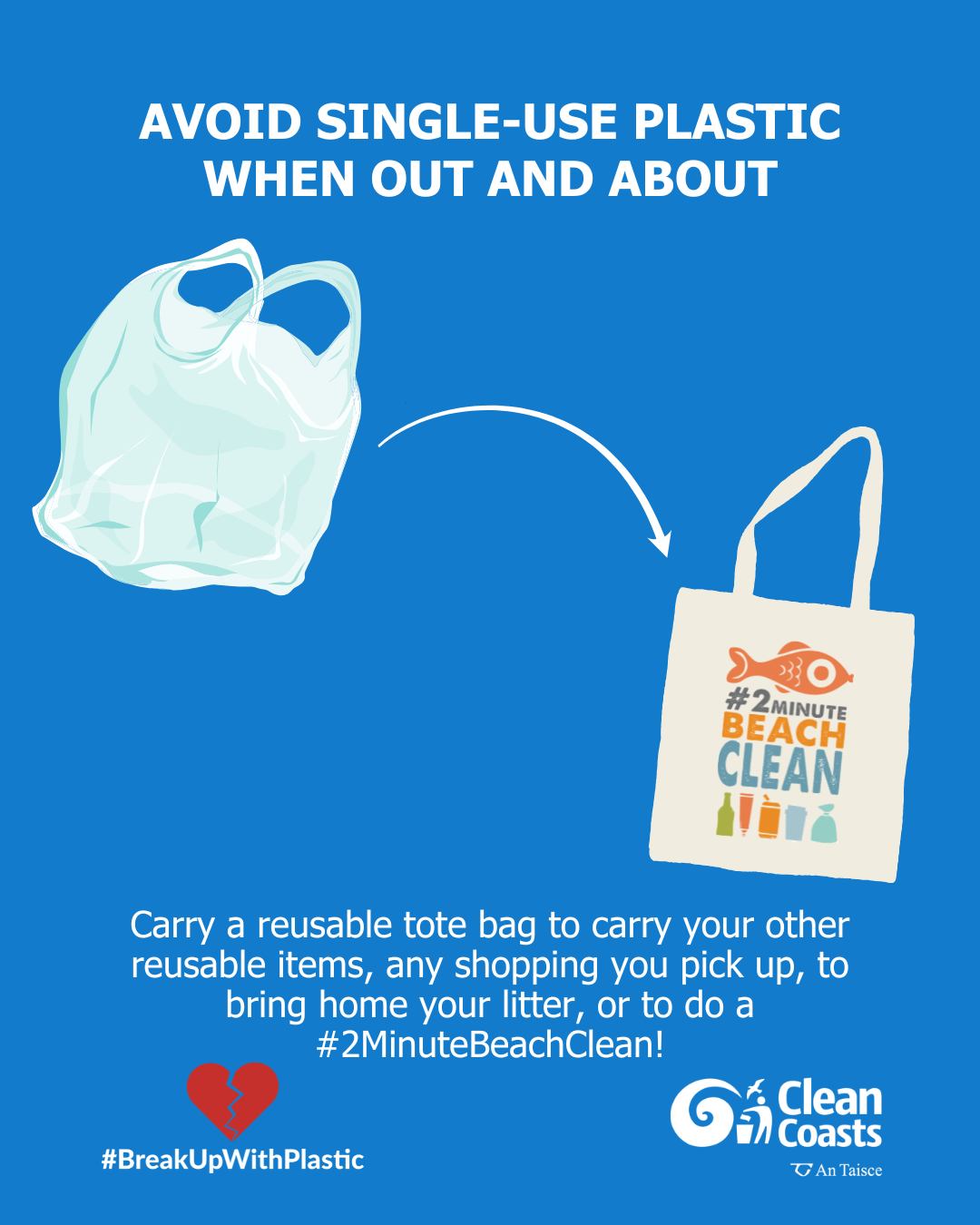
- Carry your things in a reusable bag and use that to bring back home any litter or waste, or you could even do a #2MinuteBeachClean
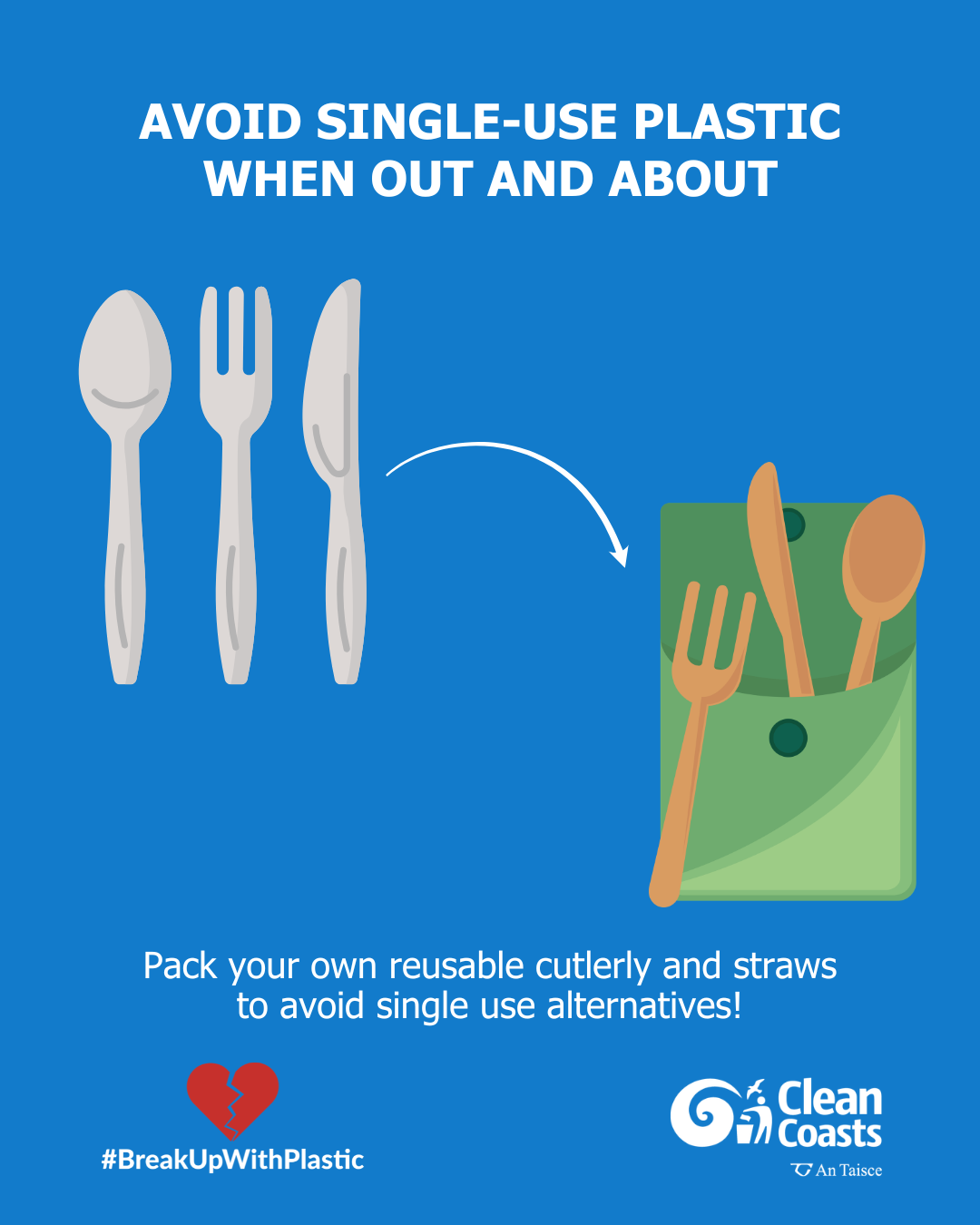
- Plastic cutlery, straws and plates have officially been banned in the EU, so if you are planning to eat on the go and want to avoid paper utensils make sure you have your reusables with you!
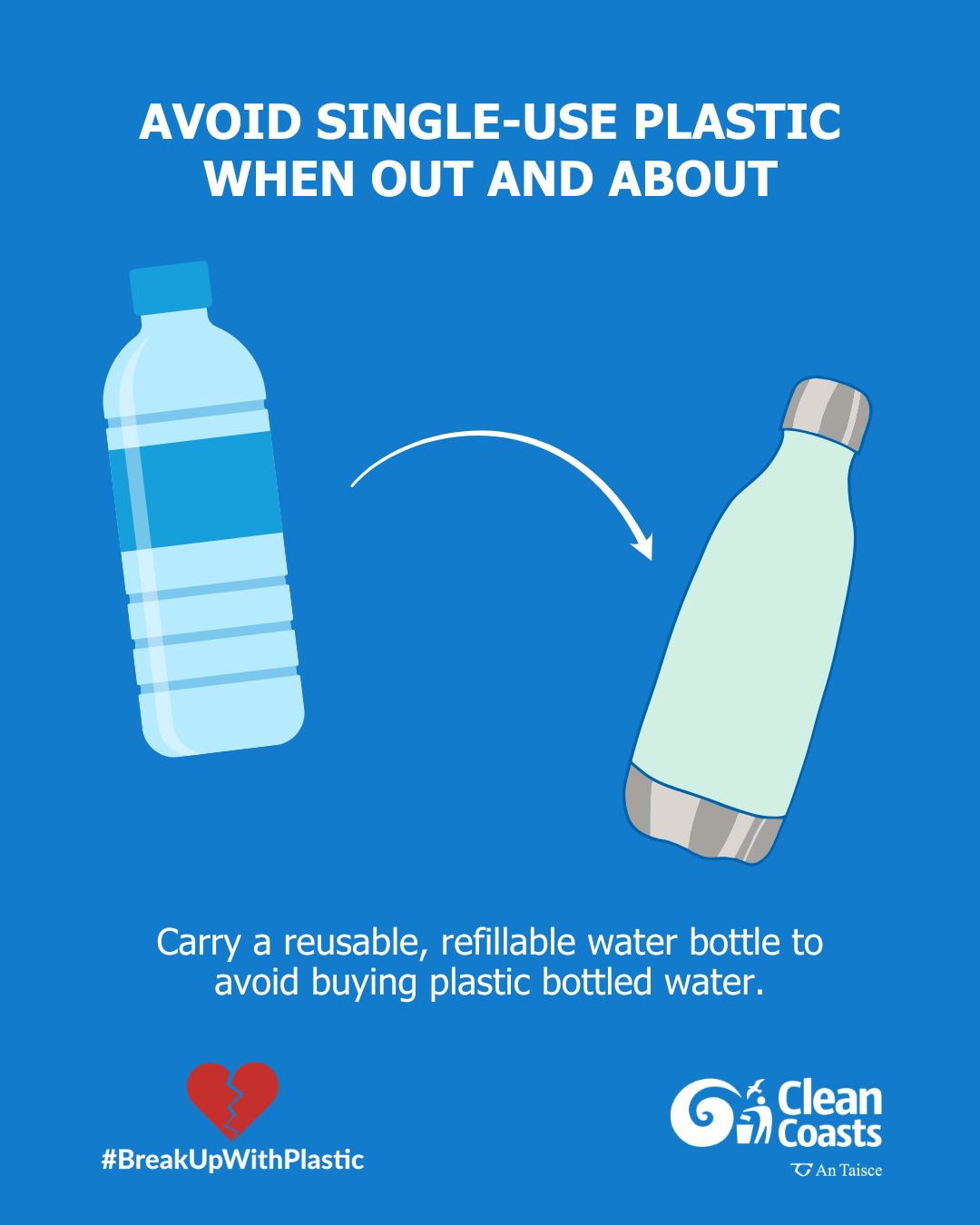
- Don’t buy bottled water, instead fill up your reusable bottles before leaving home, in some cases cafe’s will also refill your water bottle for you if you ask!
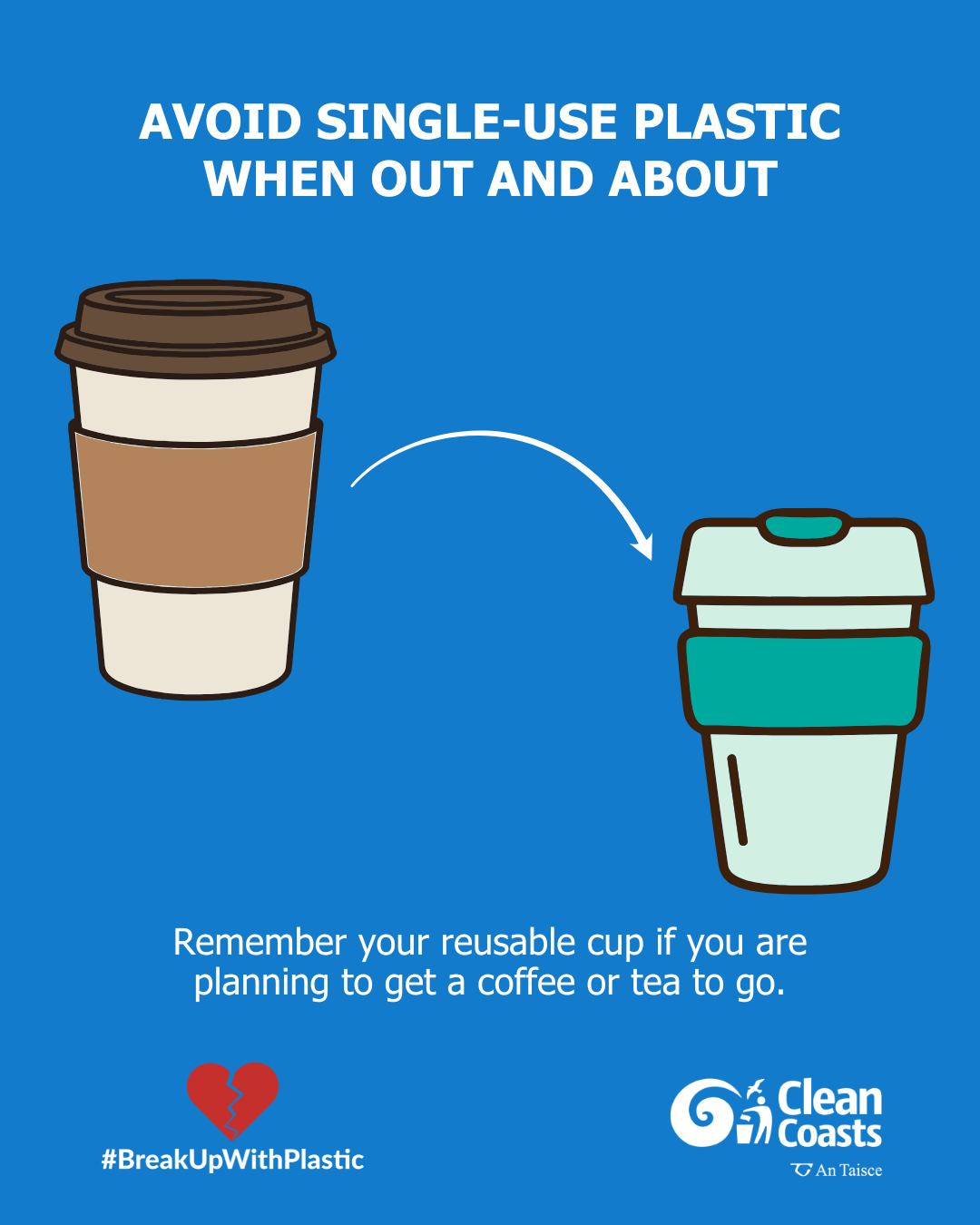
- No outdoor date is complete without coffee or tea – did you remember to pack your travel cup?
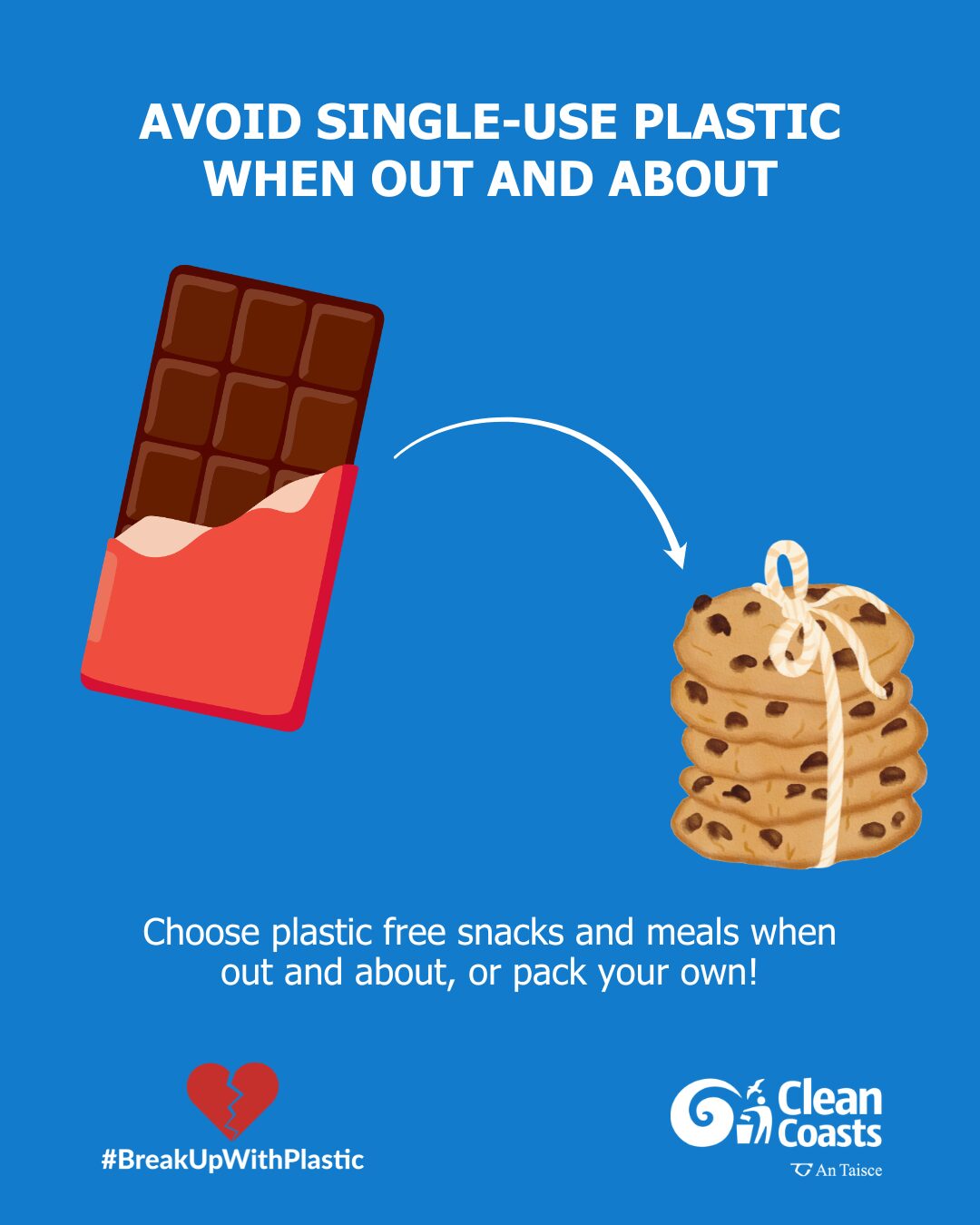
- Choose plastic free snacks and meals, or pack your own!
AT HOME
Break Up With Plastic and help the Ocean with simple actions from your home:
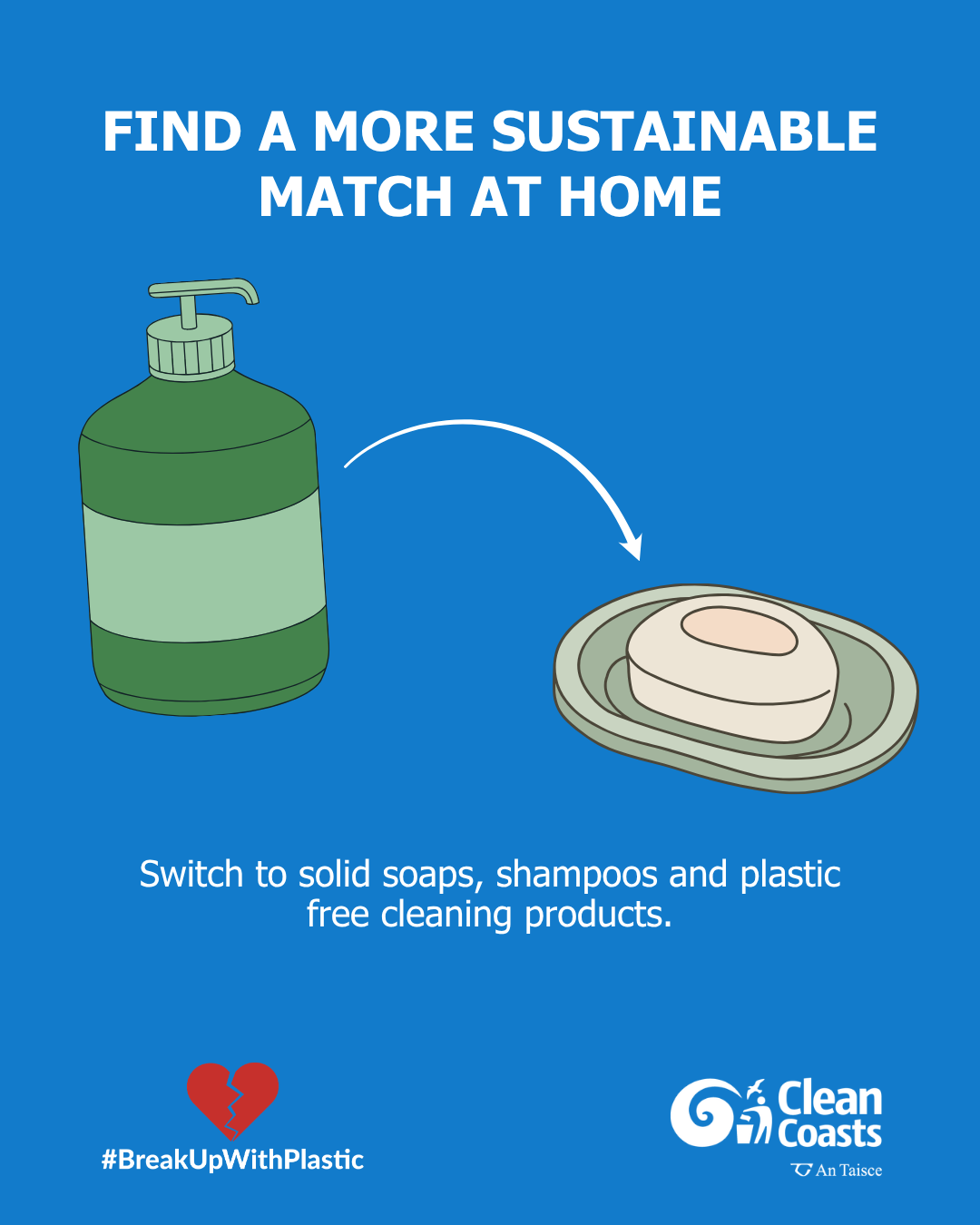
- Swap your bottled dish soap for a solid soap bar
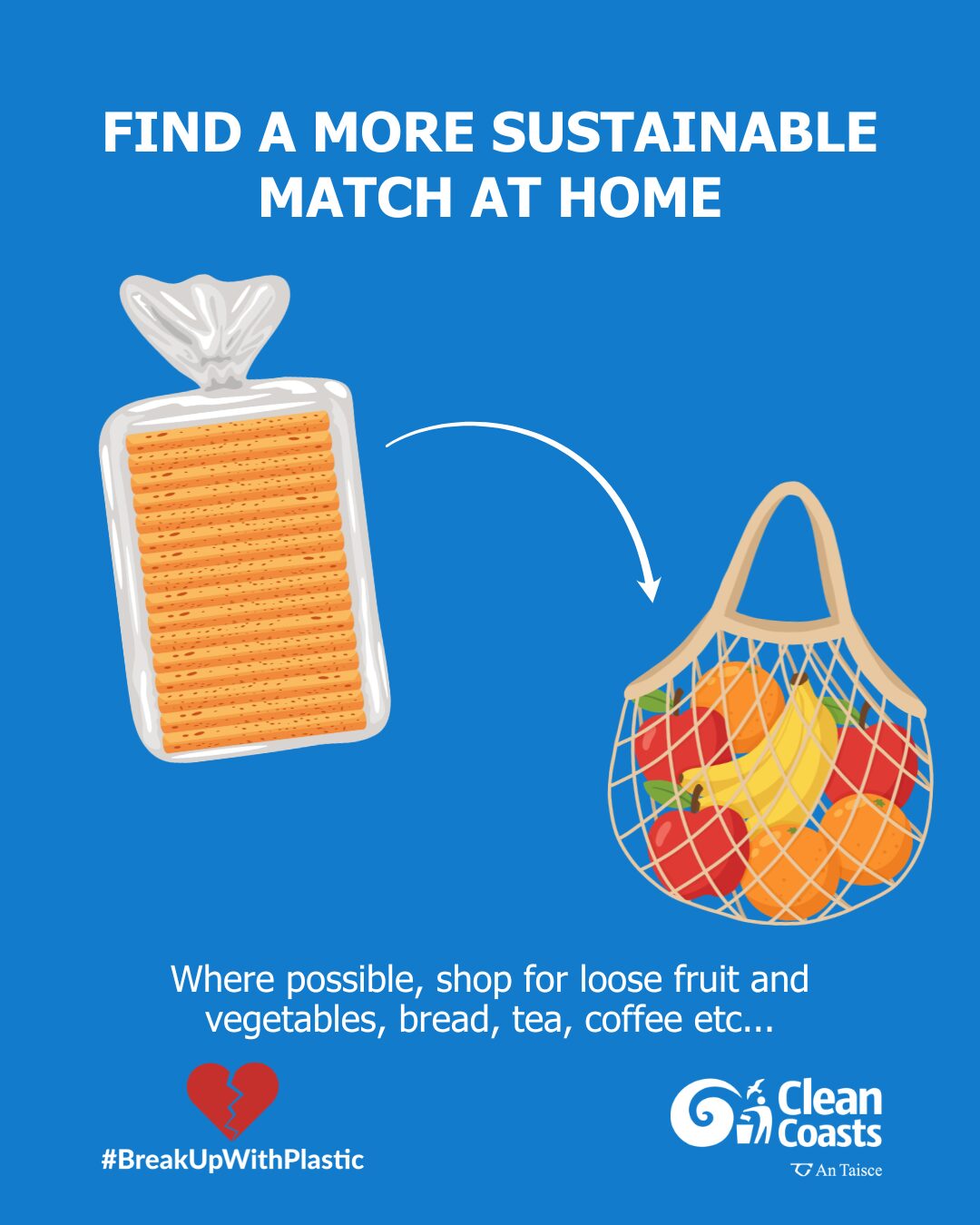
- When possible, shop for loose fruit and vegetables, tea leaves, coffee, etc..
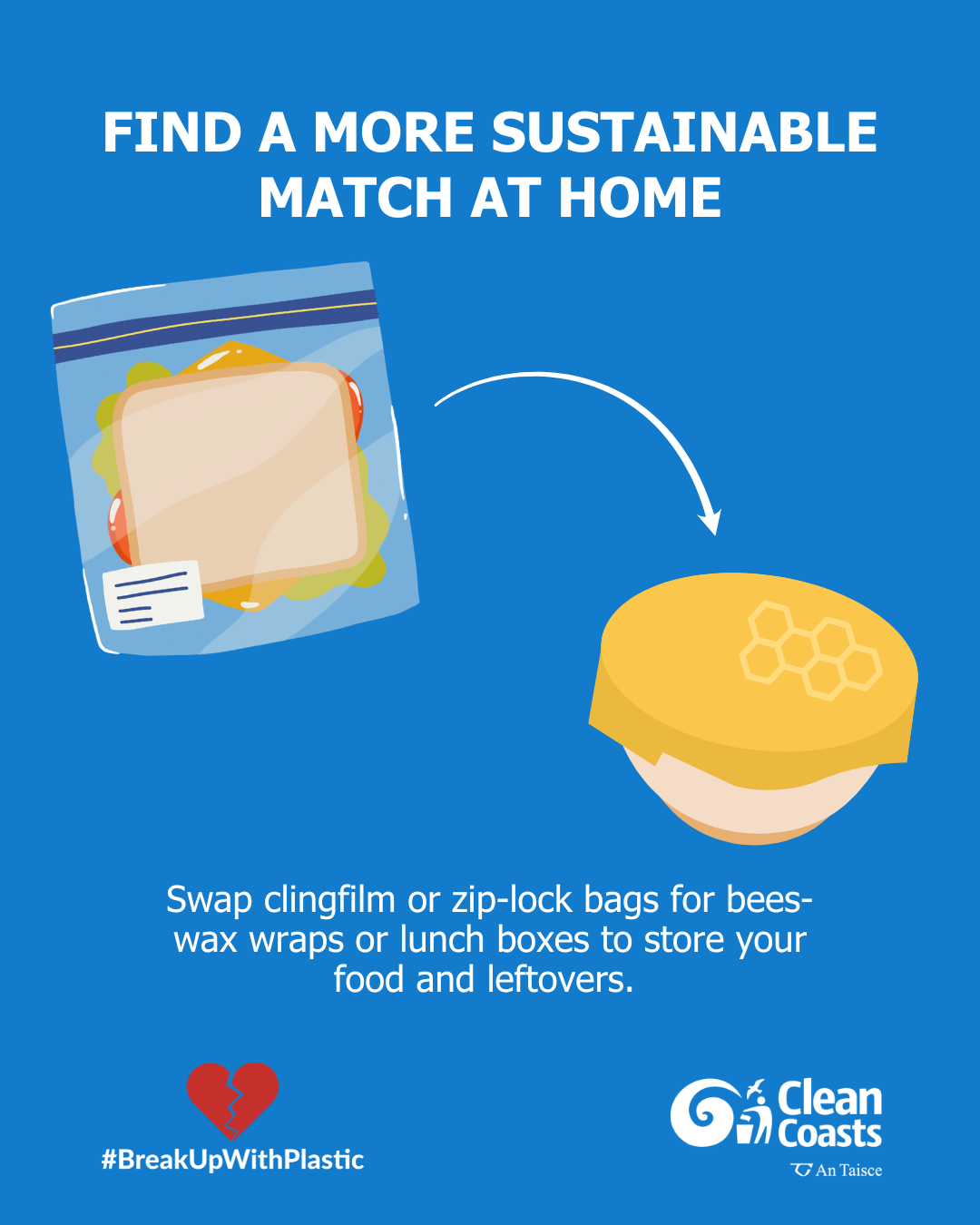
- Replace cling film and ziplock bags with beeswax wraps and lunch boxes to store your food
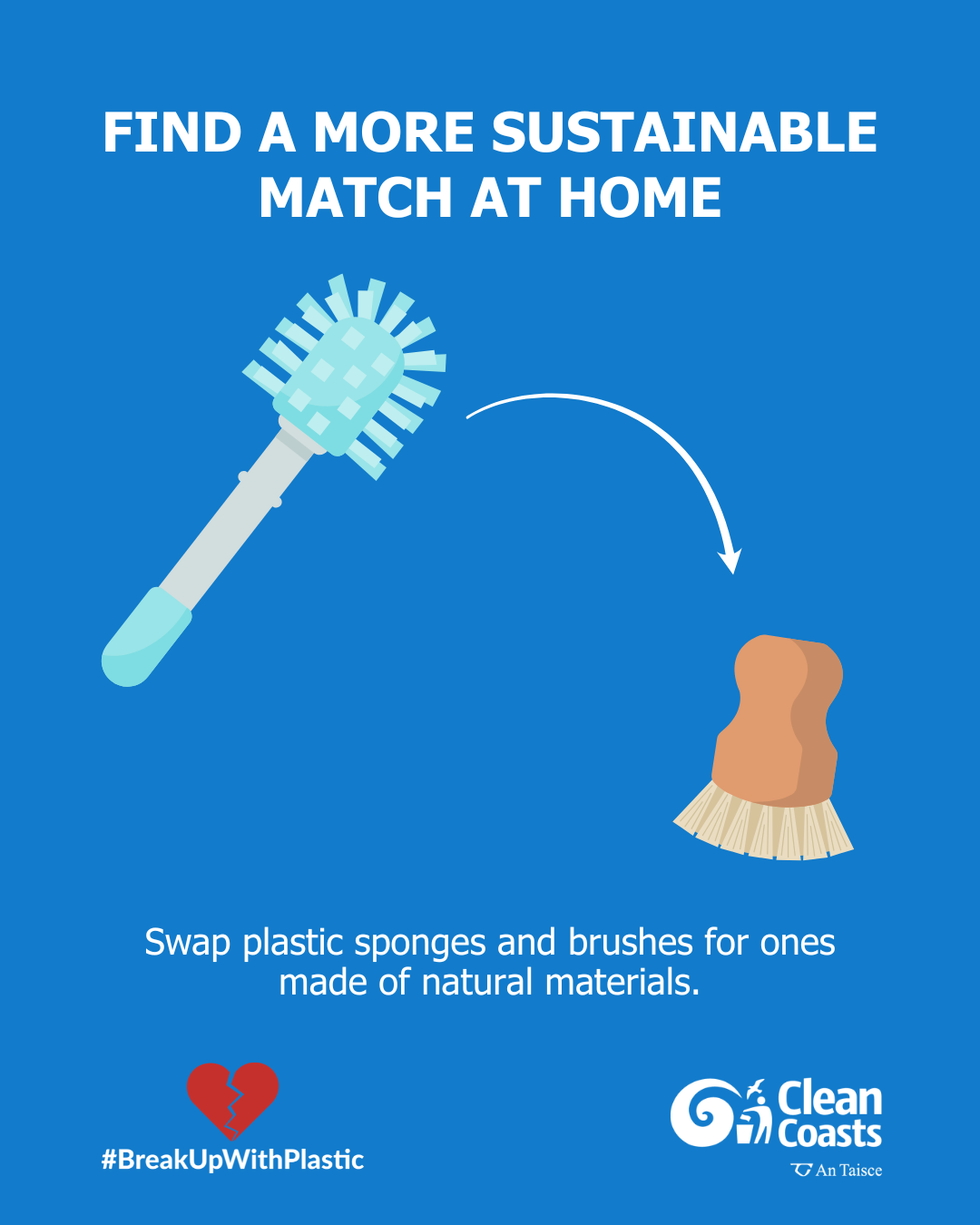
- Swap plastic cleaning sponges and brushes for reusable alternatives made from natural materials
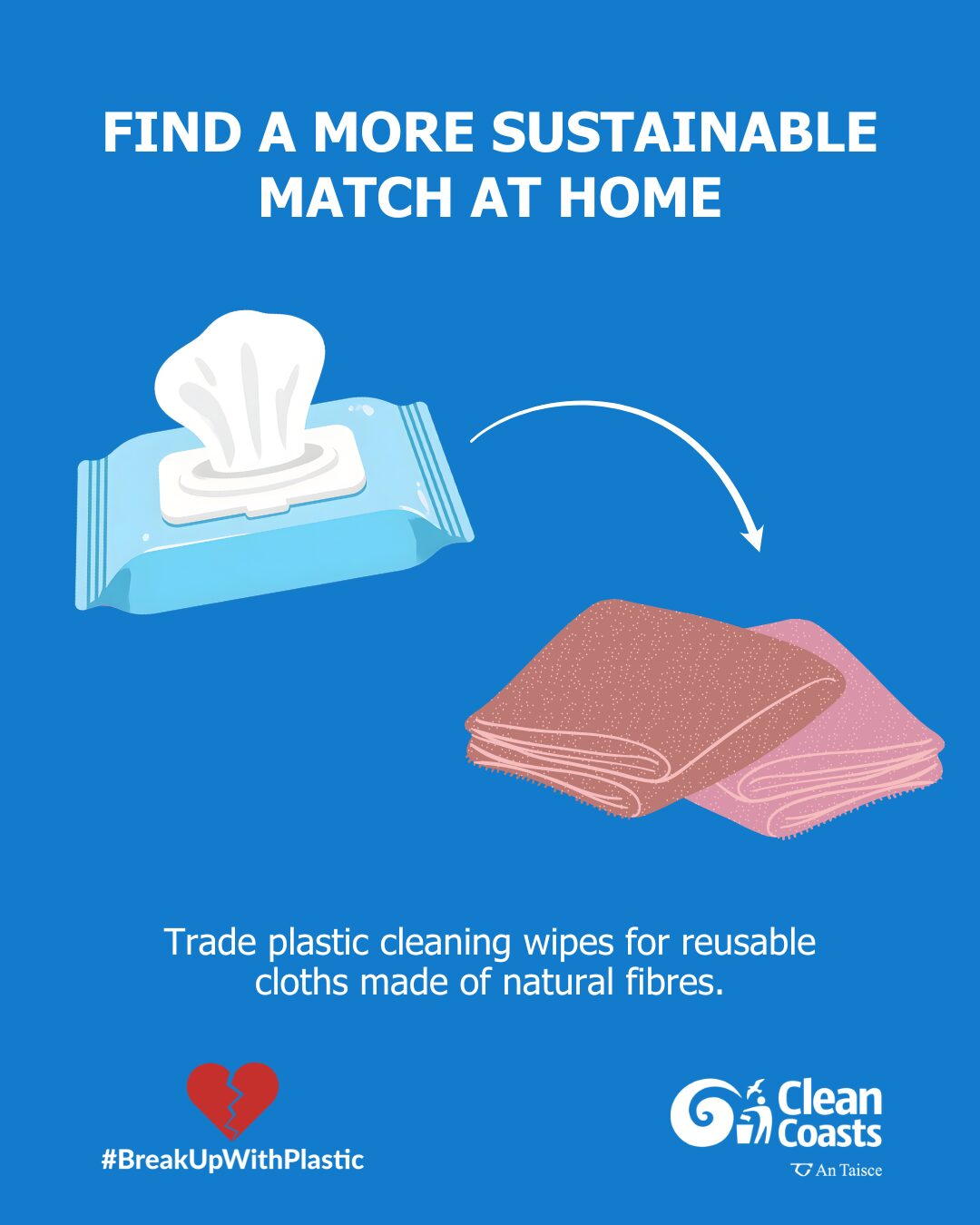
- Instead of plastic cleaning wipes, choose to use reusable cloths made from natural fibres
The Riptide Movement Plastic Oceans Web Series
The Riptide Movement’s Plastic Oceans is a three-part web series that we worked on in 2018. The series hopes to add to the urgent and important debate about how to solve the global plastic crisis and the devastating effect it is having on our marine life.
The Clean Coasts programme took the Riptide Movement along the incredible Irish coastline and met with some of Ireland’s leading marine biologists, researchers, campaigners and Clean Coasts volunteers to discover the real impacts of plastic in our oceans and what it means for the future of all life on our planet, including us.